Executive Intelligence Snapshot
Indonesia and Russia are deepening their strategic partnership across trade, energy, defence and technology, with Jakarta pursuing cooperation with Moscow as part of a broader strategy of strategic autonomy and external diversification.
The relationship is not indicative of formal bloc alignment, but reflects Indonesia’s use of strategic hedging to maximise its economic and geopolitical leverage amid intensifying competition among major powers in the Indo-Pacific.
Context
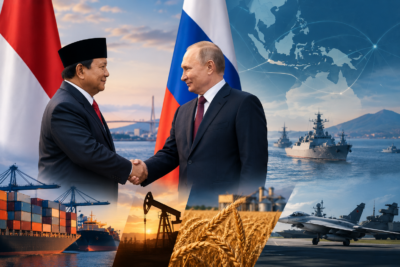
On 3 September 2026, Indonesian President Prabowo Subianto met with the President of the Russian Federation, Vladimir Putin, in Vladivostok. President Putin emphasized that Indonesia remains one of Russia’s key partners in the Asia-Pacific region.
The Russian President highlighted the Indonesia–EAEU Free Trade Agreement, signed on 21 December 2025 and undergoing the remaining ratification procedures required for its entry into force. The agreement aims to eliminate tariffs and significantly enhance bilateral trade.
Indonesia is also seeking to expand imports of Russian crude oil and fertilizers, intended to stabilise domestic prices and secure essential industrial raw materials, while agricultural trade remains another area of bilateral cooperation.
Furthermore, the Indonesian Ministry of Investment and the state-owned enterprise Pupuk Indonesia signed a memorandum to conduct a joint feasibility study on constructing a urea-based fertilizer plant in Vladivostok, a strategic logistical hub for Pacific markets. This development is of particular significance given the ongoing global fertilizer crisis triggered by Middle Eastern instability.
The two parties also initiated a dialogue to expand the supply of technological components and defence equipment. This was accompanied by plans for joint consultations and military exercises between their respective Ministries of Defence, aimed at bolstering maritime security.
Overall, bilateral cooperation spans several key sectors, including defence, trade, and tourism.
Why Does It Matter?
The rapprochement between Russia and Indonesia stems not from ideological affinity, but from a calculation of mutual expediency based on geoeconomic, security, and global balancing vectors.
Indonesian foreign policy is rooted in the historical principle of Bebas dan Aktif (“Free and Active”), which eschews rigid alliances in favour of strategic non-alignment and active engagement. Under the presidency of Prabowo Subianto, a former general and Minister of Defence, this doctrine has evolved into an assertive pragmatism.
Jakarta seeks to diversify its defence partnerships and avoid excessive dependence on any single external supplier. Cooperation with Moscow therefore contributes to Indonesia’s broader strategy of maintaining strategic autonomy.
With a population exceeding 275 million, Indonesia requires stable supplies of wheat, fertilizers (of which Russia is a leading global exporter), and hydrocarbons at competitive prices to curb inflation and sustain industrial growth.
The South Asian country’s BRICS membership and engagement with the EAEU reinforce Jakarta’s effort to position itself as an influential Global South actor while maintaining strategic autonomy.
For Moscow, the Indo-Pacific represents the linchpin of its geoeconomic realignment following the deterioration of relations with the Euro-Atlantic bloc. Demonstrating that the world’s fourth most populous nation and Southeast Asia’s largest economy openly cooperates with the Kremlin directly undermines Western efforts to isolate Russia.
Indonesia further offers Moscow a potential growth market for energy, fertilizer and nuclear-technology cooperation, while providing an additional destination for Russian commodity exports. In May 2026, Rosatom and Prabowo discussed promising areas of Russian-Indonesian cooperation in the peaceful uses of nuclear energy, including the development of nuclear power projects, nuclear infrastructure, personnel training, and non-energy applications of nuclear technologies. It also offers Moscow an additional non-Chinese market, contributing to the diversification of Russia’s trade relationships in Asia.
Joint maneuvers, such as the historic Orruda naval exercise in the Java Sea (2024), allowed the Russian Pacific Fleet to maintain a visible and recognized presence in one of the world’s most critical maritime routes. The second Orruda exercise held off Vladivostok in on 29-20 July 2026, strengthened bilateral military interoperability and provided a framework for limited Russian–Indonesian maritime cooperation.
The deepening Moscow–Jakarta partnership has implications for great-power competition in the Indo-Pacific. Indonesia’s continued defence engagement with Russia illustrates the limits of bloc-based alignment in Southeast Asia and the persistence of strategic hedging among ASEAN states.
For Indonesia, closer ties with Russia provide an additional strategic partner through which Jakarta can diversify its external relationships and avoid excessive dependence on either China or the United States.
Interaction among nations with distinct political systems and economic requirements outside Western financial and security institutions accelerates the diversification of economic and financial networks beyond traditionally Western-led institutions. Both countries are also expanding local-currency settlement mechanisms, reflecting broader efforts to reduce exposure to Western financial infrastructure.
Ultimately, the Russian-Indonesian rapprochement does not signal a formal military alliance rather than alignment against the West, but rather the manifestation of a realpolitik model in which middle and major regional powers leverage competition among major powers to maximize their national interest and sovereignty.
Outlook
The deepening Russia–Indonesia partnership reflects Jakarta’s broader strategy of strategic hedging and diversification rather than alignment with Moscow or opposition to the West.
By expanding economic, defence and energy cooperation with Russia while maintaining relations with China, the United States and other major powers, Indonesia seeks to preserve strategic autonomy and maximise its leverage within an increasingly multipolar international system.
